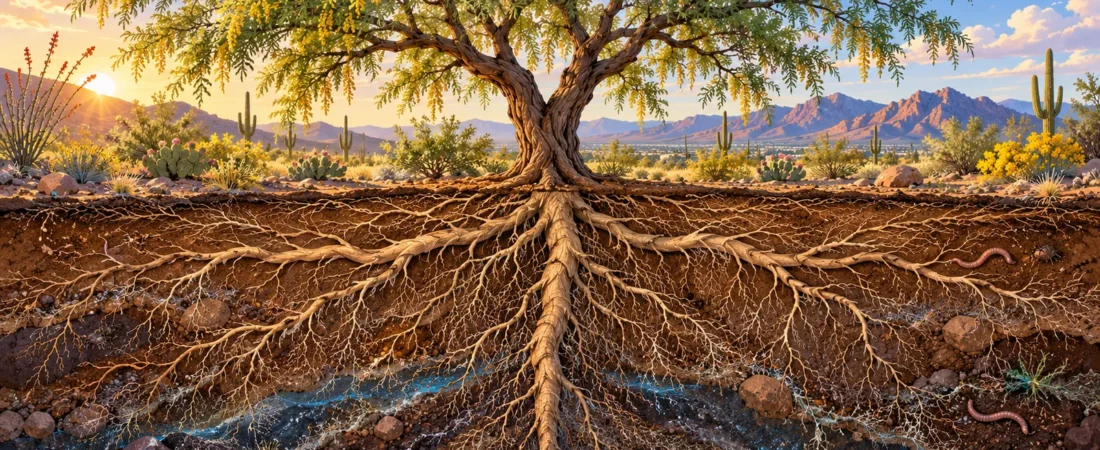
When people talk about mesquite trees and their roots, the taproot usually gets all the attention. That makes sense. Mesquite is famous for sending roots astonishingly deep in search of water. Velvet mesquite roots have been documented at depths of about 175 feet under favorable conditions.
But focusing only on the taproot misses most of what makes a mesquite root system so remarkable.
A mesquite is not simply a tree with one giant root running straight down. It is better understood as a tree connected to a large, adaptable underground network. Depending on the soil, available water, depth to groundwater, geology and the way the tree was established, that network may include a deep central root, major lateral roots stretching far beyond the canopy, shallow feeder roots close to the soil surface and smaller roots occupying different layers of soil.
That flexibility is part of what allows mesquite to live where it does.
Velvet mesquite, one of the characteristic mesquites of the Sonoran Desert, can exploit a surprisingly large volume of soil. Where deep water is available, roots can penetrate downward toward it. Where soil is shallow or moisture remains closer to the surface, the tree can instead develop an extensive system of lateral roots. In some conditions those laterals are concentrated only about 6 to 12 inches below the soil surface.
Research on mesquite in desert soils has documented lateral roots extending more than 50 feet from an individual plant. Those roots crossed several different soil types, descended through cracks and channels in hardened caliche, and also produced branches that grew upward to within inches of the soil surface.
So the underground shape of a mesquite can look very different from the simple diagram we tend to imagine.
The taproot is still extraordinary. It can give a mesquite access to moisture far beneath the surface, but it is only one part of a root system designed to exploit water wherever it becomes available.
That is something I have learned to pay much more attention to in my own garden.
Before Tucson’s serious summer heat arrives, I want my trees and other plants developing roots as deeply and widely as possible. I have noticed a major difference between plants that had easy access to frequent surface water and plants that were encouraged to build a much larger root system before the heat arrived. The plants with those established roots can be remarkably resilient once summer sets in.
Part of what interests me about mesquite is that its roots are not simply sitting underground absorbing whatever water happens to reach them.
Researchers studying mature velvet mesquite in southeastern Arizona have documented water actually moving through the root system in different directions depending on soil conditions. When the upper soil was dry, water from deeper sources could move upward through the taproot and then outward through lateral roots into shallower soil. When the surface soil was wet, the direction could reverse and water could move downward. This process is called hydraulic redistribution.
That is an extraordinary thing to think about.
The tree is connected simultaneously to different parts of the soil profile. Its roots are not merely drinking from one reservoir. They form a system through which water can move in response to differences in moisture throughout the soil.
That helps explain why the lateral roots deserve as much attention as the famous taproot.
Shallow roots allow mesquite to take advantage of small rainfall events that may wet only the upper few inches of soil. Deeper roots can reach moisture unavailable to most shallow rooted plants. Mesquite roots have even been observed growing back upward toward the surface, branching near the top of the soil where they can capture brief desert rainfall.
A mature mesquite can therefore occupy several different water zones at once.
That enormous root system also supports what is happening above ground during Tucson’s extreme summers. Water absorbed by the roots moves through the tree and eventually leaves through the foliage by transpiration. That movement of water is tied to photosynthesis, nutrient transport and temperature regulation. A tree with access to a large volume of soil has far more options when the upper few inches have become hot and dry.
This is one reason I have become skeptical of treating the phrase “drought tolerant” as though it describes a permanent property of a plant regardless of how that individual plant developed.
A mesquite growing naturally from seed has the opportunity to begin constructing its root system immediately. While we are watching a tiny plant above the ground, much of its development may be taking place underneath it.
A mesquite raised in a nursery container has experienced something completely different.
There is a physical wall only inches away from the seedling. A root that naturally would have continued downward or outward encounters the bottom or side of a pot instead. Depending on how the tree was propagated, how long it remained in each container and how its roots were managed, its original root architecture may be altered before the tree ever reaches the landscape.
That does not mean every nursery grown mesquite is damaged or incapable of becoming a healthy tree. It does mean that the root system you cannot see deserves serious consideration.
A native species is not automatically the same thing as a naturally developed individual.
And the root system is not merely plumbing.
Roots physically change the soil they grow through. They follow cracks and pores and create new channels. Fine roots continually grow, die and are replaced. Those old root pathways can become routes for water, air and future biological activity.
The area immediately surrounding living roots is also one of the most biologically active parts of the soil. Roots release carbon compounds into this zone, feeding and interacting with microorganisms. Fungi and bacteria associate with roots, while the roots themselves alter moisture, chemistry and soil structure.
Under an old mesquite, then, there is not simply a buried wooden framework holding up the trunk.
There is an active interface between tree, water, minerals, fungi, bacteria, organic matter and soil structure.
That is the part of mesquite that I think deserves more attention.
We see the spreading canopy. We notice the filtered shade. We see birds using it, insects visiting its flowers and pods covering the ground. We sit beneath it because a mature mesquite can transform a piece of exposed desert into a completely different environment.
But much of what makes that possible is happening underground.
The visible tree is only part of the organism.
Beneath our feet may be deep roots following moisture downward, major lateral roots stretching dozens of feet away, fine roots responding to a recent rain, roots turning upward toward the surface, and water moving through the root network from one part of the soil profile to another.
The famous taproot deserves its reputation.
It just should not get all the credit.
And if you are thinking about growing a mesquite of your own, think twice before automatically buying a nursery tree that has spent its early life confined to a pot. Mesquite is adapted to this desert through an extraordinary root system, and in many individuals that includes a strong taproot established while the tree is young. A container grown tree may never have had the opportunity to develop that architecture naturally.
That does not mean every nursery mesquite is a poor tree. It means the roots deserve as much attention as the trunk and canopy. Ask how the tree was grown. Consider how long it has been containerized. Look at the roots when possible. And consider whether starting a mesquite from seed or planting a very young tree might give it the opportunity to develop the deep, wide and complex root system that makes mesquite so remarkable in the first place.
,
,