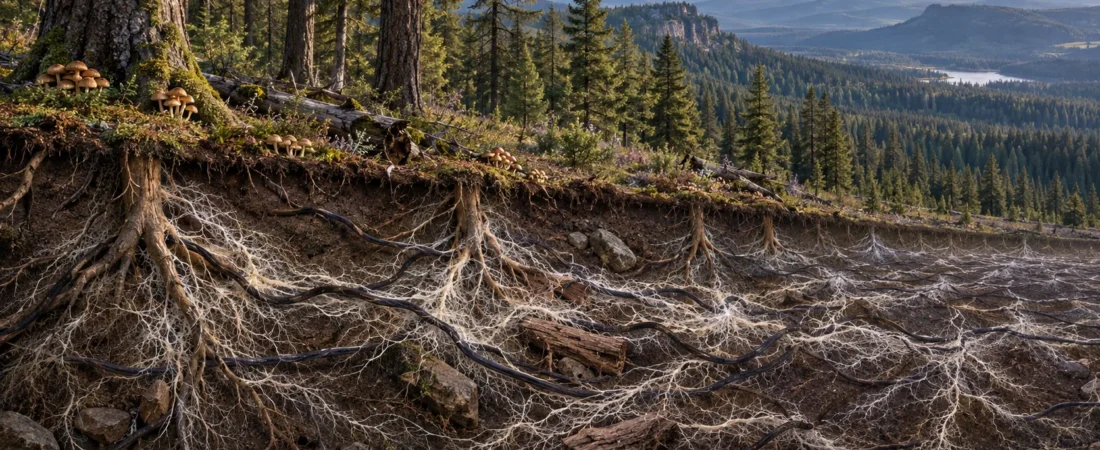
Ask someone to picture the largest organism on Earth and they will probably think of a blue whale. That makes sense. Blue whales are enormous, and they have the advantage of being visible.
The organism usually considered the largest is much harder to see. Most of it is underground in eastern Oregon, quietly spreading through soil, wood, and tree roots.
It is a fungus.
More specifically, it is an individual Armillaria ostoyae living in Malheur National Forest. It is commonly called the Humongous Fungus, which is not the most creative name anyone has come up with, but it is difficult to argue with.
The fungus covers approximately 2,400 acres, or nearly four square miles. You could walk across part of it without realizing you had encountered anything unusual. There is no enormous mushroom rising above the trees. No cap the size of a building. Nothing that looks like it belongs in a science fiction movie.
There are mushrooms, but they are only the temporary reproductive structures produced by the fungus. The main organism consists of mycelium growing through wood and black cordlike structures called rhizomorphs, which travel through the soil and between tree roots.
A mushroom is somewhat like an apple on a tree. It is visible, it serves a purpose, and it gets most of the attention, but it is not the entire organism.
That distinction is part of what makes fungi so interesting. What we see above the surface can be a very small and temporary part of what is actually there.
How Do We Know It Is One Organism?
Scientists did not decide this because mushrooms appeared across a large area and looked alike. That would not be enough. Many separate fungi of the same species can live close together, just as a forest contains many individual trees of the same species.
Researchers collected fungal samples from dead and living trees showing signs of root disease throughout the forest. They identified the samples using genetic testing and then compared cultures to see whether they were compatible.
When genetically different individuals of Armillaria meet, they normally recognize each other as separate and form a boundary. Samples from the same individual can grow together because they belong to the same genetic organism.
The researchers identified several separate individuals in the area. One of them covered approximately 965 hectares, with matching samples found nearly 3,810 meters apart.
That is about 2.4 miles from one end to the other.
The researchers call an individual like this a genet. It began from one genetic individual and continued growing outward through the forest, probably for thousands of years.
Its estimated age ranges from approximately 1,900 to 8,650 years. That range is wide because nobody was present to record when it started, and fungi do not leave convenient birth certificates. Researchers estimated its age using different possible rates for how quickly the fungus spreads through a conifer forest.
Even the youngest estimate would mean it was already growing before the Roman Empire reached its largest size.
It Is Not Just Sitting There
The Humongous Fungus is not a harmless web resting beneath the trees. Armillaria causes root disease. It spreads into living trees, damages their roots, and can eventually kill them.
The fungus also grows through dead wood and continues moving through the forest as roots come into contact with infected material. Its rhizomorphs resemble black shoestrings and allow it to cross sections of soil between food sources.
This makes the organism impressive, but it also makes it a serious forest pathogen. It is possible for something to be biologically remarkable and destructive at the same time. Nature does not separate everything into helpful and harmful categories for our convenience.
Is It Really the Largest?
This is where the answer becomes slightly less tidy.
The Oregon fungus is the largest known fungal individual and has been called the largest living organism for years. In 2022, however, researchers reported that a single clone of seagrass in Western Australia may cover approximately 200 square kilometers. That is much larger by area.
Pando, a colony of genetically identical aspen trees in Utah connected through one root system, is another competitor when organisms are compared by weight.
The title depends on what is being measured, how an individual organism is defined, and how much uncertainty is allowed in the estimates. Calling the Humongous Fungus one of the largest known organisms is accurate. Calling it the largest known fungus is safer.
That may sound less exciting, but nearly four square miles of one fungus is still difficult to dismiss.
Mushrooms Are Stranger Than the Grocery Store Suggests
Most people encounter mushrooms as a small package of white buttons sitting under plastic in a grocery store. There is nothing wrong with button mushrooms, but they represent a very narrow introduction to an entire biological kingdom.
Some mushrooms grow in dense shelves. Some resemble coral, feathers, teeth, cups, or ears. Some digest wood. Some form relationships with plant roots. Some produce mushrooms for only a short period and then disappear from view while the main organism remains alive beneath the surface.
And at least one of them has spent thousands of years occupying a section of Oregon larger than many towns.
You do not need to begin by searching a forest for honey mushrooms. Wild mushroom identification requires real knowledge, and Armillaria is not the best place to begin experimenting with dinner.
Try an Italian oyster mushroom from a local grower instead. Pull the cluster apart, cook the pieces until the edges brown, and pay attention to the texture. After that, try lion’s mane, chestnut, pioppino, or another cultivated mushroom you have never used before.
Then keep looking.
The mushroom on the plate is only one small part of the subject. In some cases, the rest of it may extend for miles.
The measurements, age estimate, and testing method were verified through the 2003 Forest Service research record and the Malheur National Forest management plan. The qualification concerning the largest organism by area reflects the 2022 seagrass genetics study.