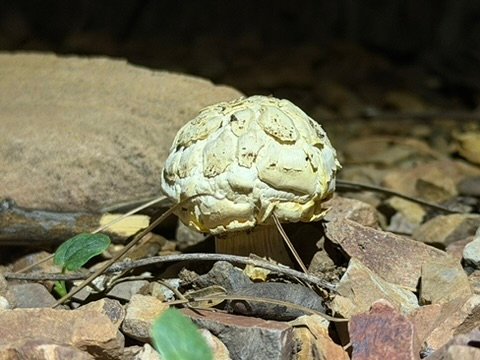
When you grow mushrooms there is this point where the mushrooms are done and you are left with this block that looks like it has already served its purpose. You got the mushrooms out of it, maybe two or three flushes if things went well, and now you have this big chunk of sawdust or straw or whatever it started as, all bound together with mycelium.
The mushrooms may be finished using it in the way we wanted them to, but there is still a lot going on in there. The fungus has spent weeks or months growing through that material, breaking it apart and changing it. It has removed some things, added other things, and changed the physical structure of the substrate in ways that are probably more complicated than I understand.
That is one of the things I like about fungi. There always seems to be another process happening underneath the process you were paying attention to.
When I first started thinking about mushroom growing, I mostly thought about the mushrooms. You inoculate something, the mycelium grows, eventually mushrooms come out, you eat them. Pretty straightforward.
But then you end up holding this block afterward and the obvious question is, now what?
Throwing it in the trash seems ridiculous.
The Block Has Already Been Changed
A mushroom block might have started as hardwood sawdust, straw, soybean hulls or some combination of agricultural materials. Depending on the mushroom, the fungus grows through the material and starts breaking down compounds it can use.
By the time the block is finished fruiting, it is not really the same material anymore.
There is still plenty of the original substrate left, but now it has been partly decomposed and is full of fungal tissue.
You can usually see this pretty clearly. A block that started as loose sawdust has turned into something you can pick up as one piece. The mycelium has basically woven through the whole thing.
What use can I find for this strange looking thing?
I Would Rather Put It Back Into the Soil
For me the obvious place is the garden.
I already spend a lot of time trying to get organic matter into my soil. Living in Tucson, I am constantly thinking about how to keep moisture in the ground and how to get something biological happening in soil that can look completely dead when it dries out.
So taking a mushroom block that is already full of partly decomposed organic material and fungal biomass and throwing it away does not make much sense to me.
I would rather break it up and put it somewhere.
Under mulch.
Into compost.
Around plants.
Mixed into a garden bed.
Maybe buried in a shady place just to see what happens.
I am not saying every spent block needs to be treated like some magical soil amendment. I don’t know that it is.
But it is organic material, and the fungus has already started doing work on it.
That is enough to make it interesting.
Sometimes They Fruit Again
Another thing is that “spent” does not always mean dead.
A block may be finished from a production standpoint because it is no longer worth keeping in a fruiting room, but that does not necessarily mean the mycelium is finished.
If you put an old block outside where it gets moisture and the conditions happen to be right, it may fruit again.
Even in Tucson.
I like that.
You think you are done with it and then months later there are mushrooms growing out of some corner of the yard.
They are apparently not very concerned about our production schedules.
I would not count on getting another crop, especially here where it can go from pleasant to brutally dry pretty quickly, but I like the idea of giving the block the opportunity.
If it fruits again, great.
If it decomposes into the soil, also great.
There Are Still Nutrients There
The fungus does not eat everything.
It uses part of the substrate to grow and produce mushrooms, but there is still a lot left afterward.
The remaining material can contain organic matter and nutrients, and as it continues decomposing those materials can become part of whatever system you put it into.
Compost is probably one of the most obvious places.
I already put all kinds of things in my compost and a used mushroom block seems pretty tame compared to some of the stuff I have thrown in there.
You can break it apart and mix it with everything else and let bacteria, fungi, insects and whatever else shows up continue the process.
That is the part I find interesting.
The oyster mushroom does not have to be the final organism that uses the material.
It is just one step.
It Makes Mushroom Growing Feel Less Wasteful
There is some waste involved in mushroom growing.
There are bags, filters, energy for sterilization, water, grain, equipment and whatever else you use.
I am still figuring out how I feel about all of that and where it makes sense to reduce things.
But the substrate itself is one part that does not really need to become trash.
Especially when you think about where it started.
You can start with sawdust or straw, grow food on it, and then take what remains and put it into the soil.
That is a pretty decent life for a pile of sawdust.
It is not a perfect closed loop. I think people like to use that phrase a little too easily. There are still inputs and losses and things leaving the system.
But it is at least moving in that direction.
I Think We Call Things Waste Too Early
This is probably the bigger thing I keep coming back to.
We are really quick to decide that something is finished.
Food scraps are waste.
Leaves are waste.
Wood chips are waste.
Mushroom blocks are spent.
But most of those things are really just materials that we personally do not have a use for at that particular moment.
Something else usually does.
A fungus sees the dead tree differently than we do.
A worm sees the compost pile differently.
A plant sees decomposed organic matter differently.
Even the mushroom block changes depending on who gets it next.
I think that is part of why I am so interested in fungi in the first place.
They live right in the middle of this whole process of one thing becoming another thing.
A tree becomes wood.
Wood becomes fungal food.
The fungus grows mushrooms.
We eat the mushrooms.
The remaining substrate goes back into the soil.
Something else grows.
It just keeps going.
So I am probably going to keep calling it spent mushroom substrate because that is what everybody calls it.
But I don’t think it is really spent.
I think we are just done asking it to grow mushrooms.