The Mushroom Is Not the Whole Fungus
I think mushrooms get confusing because the part we notice is usually the smallest and most temporary part of the organism. A mushroom is a reproductive structure made by certain fungi. Its job is to produce and release spores. Comparing it to a fruit is not perfect, but if the mushroom is somewhat like an apple, the main body of the fungus is closer to the rest of the tree.
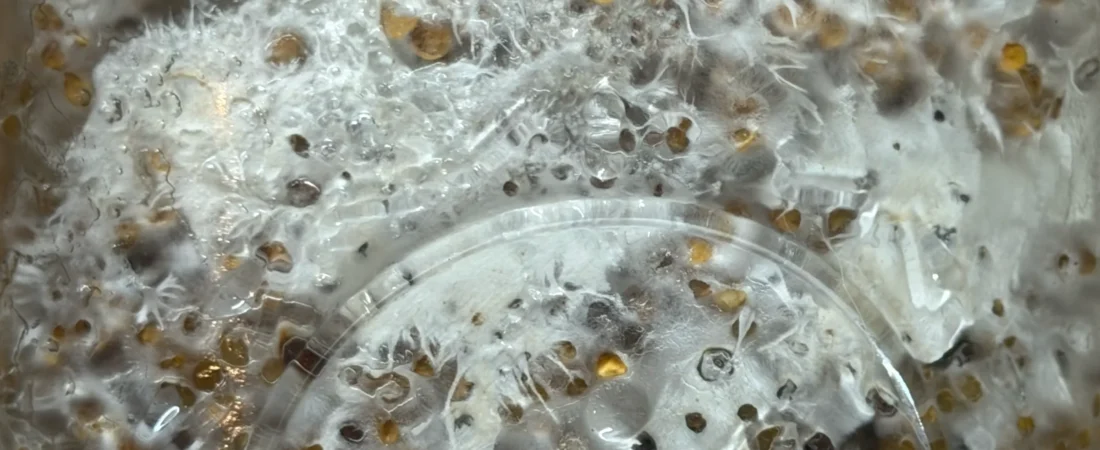
That main body is usually made of microscopic threads called hyphae. As they grow, branch, and overlap, they form mycelium. Mycelium can grow through soil, wood, leaves, compost, or whatever material a particular fungus uses as its habitat and food source.
Do Mushrooms Have Roots?
No. Roots are plant organs. Mycelium may look like roots, and both can spread through soil, but they are different structures doing different things.
A plant uses its roots to anchor itself and collect water and nutrients. A fungus grows hyphae into or across its food source, releases enzymes that break material down outside its body, and then absorbs the smaller compounds. It is almost as if the fungus places its digestive system directly into its surroundings.
You can sometimes see this yourself. Pull back damp leaf litter or turn over decaying wood and you may find thin white threads running through it. That may be fungal mycelium. The same structure can appear as white growth on a mushroom block before mushrooms form. It is not a set of tiny roots. It is living fungal tissue growing through its food.
Why Fungi Are Not Plants or Animals
Plants generally make sugars through photosynthesis using light, carbon dioxide, and water. Their cell walls are mainly made with cellulose. Animals cannot photosynthesize. We get energy by eating other organisms or material made by them, then digesting that food inside our bodies. Animal cells do not have rigid cell walls.
Fungi do something different. They cannot photosynthesize, but they also do not swallow food the way animals do. They digest material externally and absorb the results. Their cell walls contain chitin, along with other compounds. Chitin also appears in insect exoskeletons, although that does not make fungi insects or anything close to that.
Genetic evidence places fungi closer to animals than to plants, but fungi are neither. They have their own evolutionary history, body structures, methods of feeding, and ways of reproducing. That is why they belong in their own kingdom. Research using several proteins found strong support for animals and fungi as related branches rather than fungi belonging with plants. (Proceedings of the National Academy of Sciences)
What Is Mycelium Doing Underground?
Many mushroom forming fungi grow as networks of hyphae called mycelium. These networks may spread through soil, dead wood, compost, fallen leaves, or other material. They absorb nutrients, respond to changing conditions, and move materials through themselves. Some fungi decompose dead matter, some live as parasites, and others form relationships with living plants.
Mycorrhizal fungi are one particular group that connects with plant roots. The plant provides carbon compounds made through photosynthesis, while the fungus can help the plant obtain nutrients such as phosphorus and nitrogen and may improve its access to water. Their mycelium can sometimes connect with more than one plant.
Researchers have studied whether nutrients or chemical signals can move between plants connected through fungal tissue. Some movement can happen, although the details vary among fungi, plants, soils, and environmental conditions.
How Fungi Communicate and Respond
We know that some fungal networks connect plants and that materials can move through some of those connections. Researchers are still determining how common shared networks are in natural environments, how much material moves through them, which organisms benefit, and how changing conditions affect the relationships. Field studies have produced limited or inconsistent evidence for some of the broader claims made about these networks. (Nature Ecology & Evolution)
That uncertainty does not make underground fungal networks imaginary or unimportant. Fungi respond to moisture, temperature, food, damage, nearby organisms, and chemical conditions. Different parts of a mycelium coordinate growth and move materials, while plants and fungi change their behavior in response to one another.
Fungi communicate with the world around them. A plant root releases compounds, a fungus detects them, and its growth changes. One part of a mycelium encounters food, damage, moisture, or another organism, and the network responds. None of this needs to resemble human language. If an interaction can be sensed and causes a change in behavior, information has moved. Scientists may distinguish an evolved signal from an incidental cue, but the communication and response are still real.
The Ground Is Far From Lifeless
The more I understand about mycelium, the less empty the ground seems. Fungal threads move through wood, leaves, soil, and dead tissue, breaking apart cellulose and, in some species, lignin, materials most plants and animals cannot unlock on their own. Carbon, nitrogen, phosphorus, and other elements are pulled into new forms and eventually made available to microbes, plants, insects, and animals again. (Research on fungal ecosystem processes) A mushroom is only a brief shape above that process. Underneath it is a world that does not need us to notice it, quietly taking what has ended and making it available to whatever comes next.