A Beginner’s Guide to the World Around Plant Roots
When most of us think about roots, we probably picture something like underground plumbing. Roots spread through the soil, absorb water and nutrients, and hold the plant in place. That is true, but it leaves out most of what is actually happening underground.
A living root is surrounded by a constantly changing community of fungi, bacteria, other microorganisms, water, minerals, organic matter, and tiny animals. The narrow region of soil directly influenced by the root is called the rhizosphere. It may extend only a few millimeters from the root surface, but across an entire root system that adds up to a surprisingly large biological environment.
The important part is that the rhizosphere is not simply soil that happens to have a root running through it. The root and everything around it are interacting.
Roots Change the Soil Around Them
A root is not just pulling things out of the ground. It also releases / exchanges substances into the soil and organisms within.
These materials are often called root exudates and can include sugars, amino acids, organic acids, enzymes, mucilage, and other compounds. Some provide food for microorganisms. Others change the chemistry immediately around the root or act as signals between organisms.
That means soil right beside a root can be biologically and chemically different from soil only a short distance away.
I think this is where the idea of the plant as an individual organism starts becoming less useful. The plant is still obviously a plant, but underground it is constantly interacting with a larger community.
There Is a Lot Living Down There
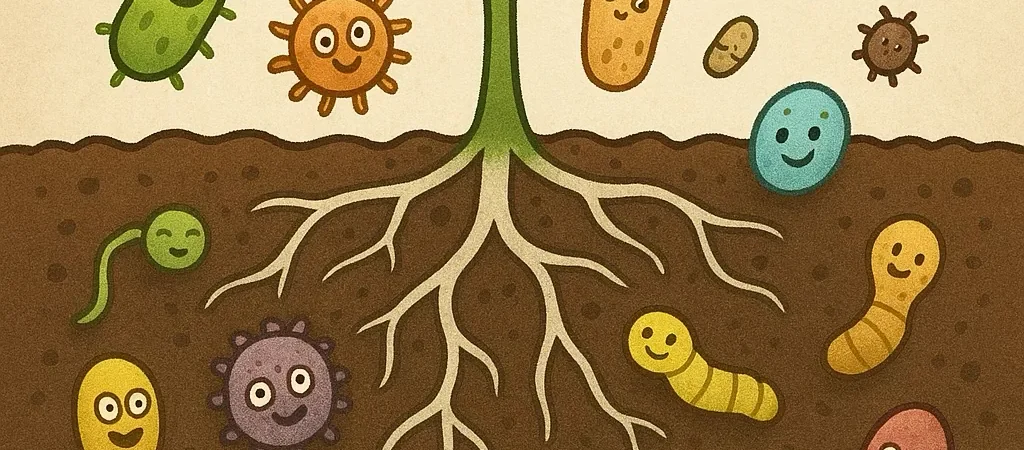
Let me hear everyone in the rhizosphere! Whooo! There sure is a lot of life down here!
The rhizosphere contains bacteria, archaea, fungi, protozoa, nematodes, microscopic animals, viruses, and a lot of other organisms.
Some decompose dead material. Some consume other microorganisms. Some compete with each other. Some form direct relationships with plants.
Mycorrhizal fungi are one of the better known examples. These fungi associate with plant roots and send microscopic filaments called hyphae outward into the surrounding soil. In many of these relationships, the plant supplies carbon compounds produced through photosynthesis while the fungus helps the plant reach water and nutrients beyond the immediate root surface.
But even that relationship is only one part of a much larger network.
The rhizosphere is not a plant surrounded by a few helpful microbes.
It is an ecosystem.
Nutrients Move Through the System
Plants need nitrogen, phosphorus, potassium, iron, calcium, magnesium, sulfur, and many other elements.
The problem is that having those elements physically present in the ground does not necessarily mean a root can use them.
Nutrients can be trapped inside minerals, organic matter, dead organisms, or living microbial cells. Soil organisms help break down, transform, and move those materials through the system.
Fungi and bacteria decompose organic matter. Other organisms eat them. Nutrients are incorporated into living bodies and released again. Minerals interact with organic compounds and water. Roots absorb some of what becomes available.
It is less like filling a container with fertilizer and more like nutrients continuously moving through a community.
That is why I think soil fertility becomes much more interesting once biology enters the picture.
The Rhizosphere Can Influence Disease
The same biological community can also affect disease.
Roots are attractive places for microorganisms because there are carbon compounds, nutrients, moisture, and living tissue nearby.
Pathogens want access to those resources too.
Other organisms can compete with them for food and space. Some microorganisms produce compounds that inhibit competitors. Others can influence how the plant responds to infection.
That does not mean a biologically active rhizosphere makes a plant immune to disease. It means disease happens inside a much larger ecological system than just one pathogen attacking one plant.
The Biology Changes the Physical Soil Too
The rhizosphere is not only about chemistry and microorganisms.
It can also change the physical structure of the soil.
Roots create channels as they grow. Fungal hyphae extend between soil particles. Microorganisms produce sticky substances. Organic matter becomes incorporated into the soil. Tiny animals move material around.
Together these processes help create aggregates, groups of soil particles held together as larger structures.
Those aggregates create pore space.
Pore space affects how water enters the soil, how long moisture remains, how easily oxygen moves underground, and where roots and microorganisms can live.
So biology is not simply occupying the soil.
It is helping build the structure of the soil.
Tucson Makes This Especially Interesting
In Tucson, the rhizosphere operates under some fairly extreme conditions.
The soil can become very hot. Water may be absent for long periods and then arrive suddenly during a monsoon storm. Evaporation is intense. Organic matter is often limited.
Under an established desert plant, however, conditions can be very different from the exposed ground nearby.
A shrub creates shade. Leaves and other material accumulate beneath it. Roots move through the soil. Water behaves differently. Animals visit. Fungi and microorganisms interact with the root system.
Life tends to concentrate around life.
That does not mean every patch of desert soil should look like a forest floor. The Sonoran Desert has its own ecology. But it does show that plants do much more than simply occupy space above the ground.
They change the environment around them.
We Still Do Not Understand the Whole Thing
This may be the part I find most interesting.
We understand many individual pieces of the rhizosphere, but putting all of them together is much harder.
An organism that benefits one plant under one set of conditions may behave differently somewhere else. Water changes the system. Temperature changes it. Soil chemistry changes it. Different plants create different conditions around their roots.
And every organism is interacting with other organisms at the same time.
So the rhizosphere is probably better understood as a constantly changing network than as a collection of separate partnerships.
The root influences the soil.
The organisms influence the root.
Water, minerals, climate, organic matter, and other plants influence both.
The more closely we look at the world immediately around a root, the less it looks like a plant growing alone in dirt and the more it looks like a community.
Now, after reading this reflection and giving it some thought: ask yourself, how does it work with modern commercial agricultural methods? We just add NPK and the plants grow fine, right?