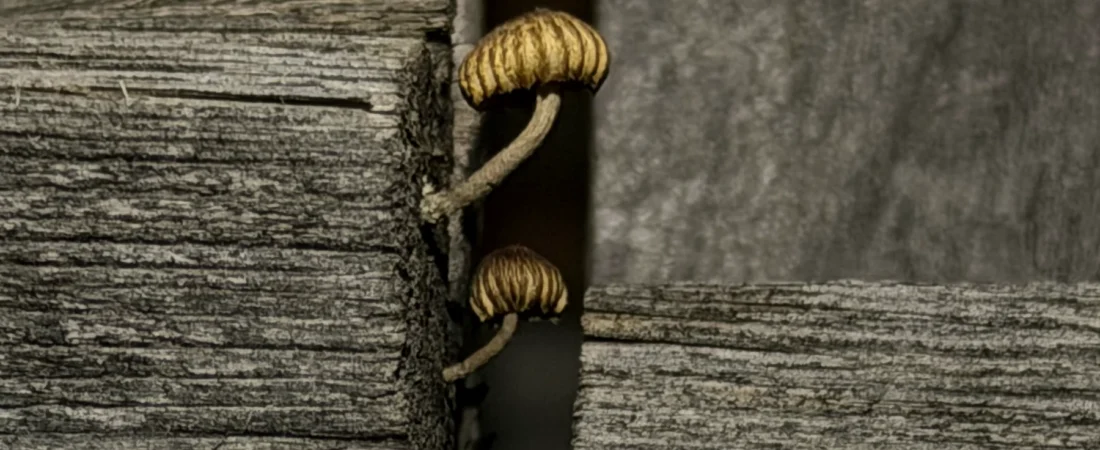
Generally, I would leave them. I have spent the last three years adding organic material to my backyard and trying to get something going in soil that started out looking pretty dead. A fungus making use of that material would not be my first concern. Whether the soil is doing well, or in the case that a child or animal may ingest an unknown mushroom, then I would be more cautious.
Mushrooms can look a little out of place here. We are in Tucson after all. But an irrigated bed with mulch and shade is a different environment from the dry ground a few feet away. Add some monsoon rain and there may be enough moisture for a fungus to produce mushrooms.
Why they show up
The mushroom is the fruiting body. Most of the fungus is mycelium, which may already be growing through the soil, mulch, or an old piece of buried wood before anything appears above ground. It has not necessarily arrived overnight, even if the mushrooms seem to have.
Wood chips, straw, dead roots, etc. provide food for decomposer fungi. We put these materials in a garden partly because we want them to break down eventually. Fungi are some of the organisms doing that work.
Compost and other amendments can bring in spores or living mycelium, and spores can arrive on their own too. You do not have to deliberately introduce mushrooms for them to find a suitable place.
Around a drip emitter, that suitable place might be quite small. A few mushrooms there do not automatically mean you are overwatering. I would check whether the soil stays saturated and how the plants are doing before changing the irrigation. I still want the tomatoes watered.
What the fungus is doing
Many mushrooms in mulch belong to fungi feeding on dead organic material. As they break it down, they participate in the recycling of nutrients. Generally these are not fungi attacking your vegetables. University of Maryland Extension
Mycorrhizal fungi have a different relationship with plants. They associate with roots and can help the plant obtain nutrients and water, while receiving carbon from the plant. Some mycorrhizal fungi produce mushrooms, but the kinds commonly associated with vegetables do not produce the familiar capped mushrooms we notice in a bed.
So I would not look at a mushroom beside a pepper and assume the two are helping each other. They may simply be living near each other. There is plenty happening in the soil without every organism having the same job.
Mushrooms tell us a fungus found conditions suitable for fruiting. They do not tell us everything about the soil, and their absence does not mean the soil is unhealthy. I like seeing biological activity, but I would not use a mushroom as a complete soil assessment.
When I would look more closely
If the vegetables are wilting, yellowing, or collapsing, then there is something to investigate. It could involve watering, drainage, disease, or another problem. A mushroom nearby does not establish the cause.
White mycelium in decomposing mulch is also different from fungal growth associated with rotting stems or damaged roots. Even then, appearance alone may not tell you what organism is involved. I would want to know what is happening to the plant before deciding the fungus needs to go.
The University of Arizona Pima County Master Gardener Plant Clinic is a local resource for that. Clear photographs of the affected plant, its base, and the surrounding soil are more useful than a picture of a mushroom by itself. Plant Clinic
When removal makes sense
The main reason I would remove an unidentified mushroom is if a child or pet might eat it. Pick up the fruiting bodies as they appear and put them somewhere they cannot be retrieved and eaten. Being harmless to a tomato plant does not make a mushroom harmless to a dog.
A vegetable bed does not make an unidentified mushroom edible either. Neither does seeing an animal eat one. If you want to eat it, you need a reliable identification from someone qualified to provide one. University of Minnesota Extension
Picking the mushroom usually leaves the mycelium in place, so more may appear when conditions are suitable. You are removing the part that someone could eat, not necessarily removing the fungus.
Otherwise, if the plants are doing well, I would generally let it carry on. I have added quite a bit of organic material to this yard. Something has to help take it apart.