Over the last three years I have added all kinds of organic material to my backyard. Pond muck, worm castings, compost, biochar, whatever I could find and thought might help. When you start with dry dead looking dirt, you spend a lot of time looking at things and wondering whether they belong in the soil instead of the trash.
Growing mushrooms adds another possibility. Some of that material could produce food before it goes back to the garden.
I’m not going to eat straw or sawdust but one can grow mushrooms on such things. They break down parts of the material that we can not and use it to grow mycelium and eventually mushrooms. There is preparation involved, and the kind of mushroom matters, but I really like the idea of getting another crop out of something that was left over from a previous one.
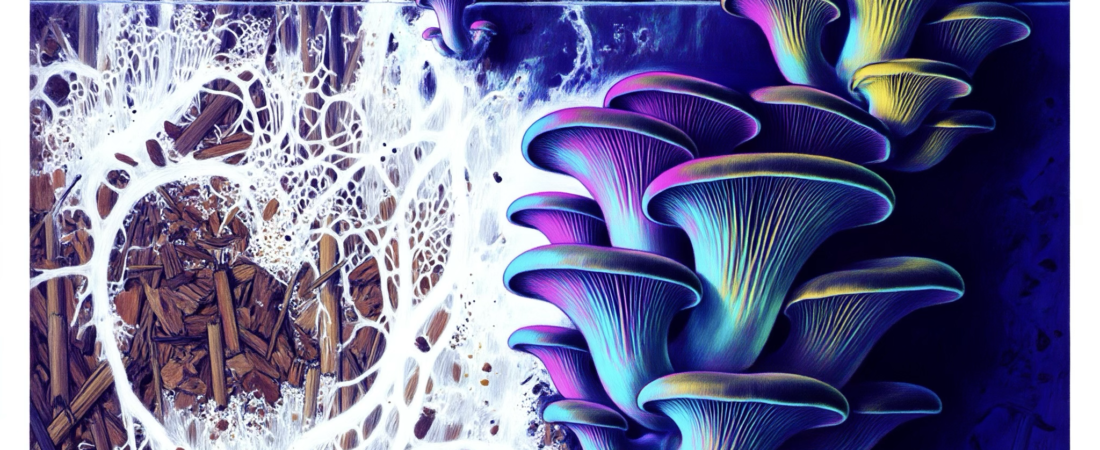
Generally when we talk about mushrooms we mean the part we can see and pick. Most of the fungus is mycelium, growing through whatever it is feeding on. It releases enzymes that break down material outside its body and then absorbs nutrients from it. That is a pretty different way of eating than ours.
Plant stems and wood contain cellulose, and wood also contains a lot of lignin, which helps make it rigid. These are not easy materials for most organisms to break down. Different fungi have different abilities, but the ones that decompose wood and other plant remains do a lot of the work of returning that material to the rest of the ecosystem.
We can arrange for some of that work to happen when growing mushrooms.
Oyster mushrooms are a good example because they can use a fairly wide range of materials. Straw is a common one. Once a grain crop has been harvested, the leftover stems can become substrate for another crop. The straw needs to be prepared properly, including getting the moisture right and treating it to reduce competing organisms before adding mushroom spawn.
Wood is another option, depending on the mushroom and the kind of wood. Hardwood sawdust is used in growing blocks, often with added nutrients. Those supplemented blocks generally need sterilization because the extra food is also attractive to things other than the mushroom you intended to grow.
The best resource is close, free, and completely absent of contaminants. If I had to choose one though, it would be free of contaminants.
Cardboard is tempting but I have never used it personally. Mycelium will certainly colonize it.
I have collected coffee grounds from many coffee shops and it is a plentiful resource, but unless it is used fairly quickly or preserved, bacteria, molds and anything that can will start to grow there which changes the composition and does not make for good start for a substrate.
There are many other possibilities in agricultural leftovers. Rice straw, corn stalks, seed hulls, sugarcane residue, etc. Some materials work with particular mushrooms and some need to be mixed with other ingredients. Locality matters. A material might work very well in a study and still make no sense for someone who would have to ship it across the country.
For me the more useful questions are what is already available around Tucson. What are people regularly getting rid of, where did it come from, and is there a mushroom that could use it? Then there are the less exciting questions about collecting it, storing it, preparing it, and whether the results justify all of that.
There is also a difference between using fungi for bioremediation and using fungi for food. Some fungi can absorb contaminants from their surroundings. Their ability to grow on a material does not prove that the mushrooms are safe to eat. I would want clean material with a known source, especially if someone else was going to eat what I grew.
The phrase “turning waste into food” can make the whole thing sound more mysterious (and gross) than it is. The fungus has water, carbon, minerals, and other nutrients to work with. It uses some of those resources to build its own tissue. Some of the carbon goes back into the air through respiration, and a portion of the original material remains after the crop.
That leftover material interests me almost as much as the mushrooms.
It is known as spent substrate however it still retains a lot of potential. It can be used for soil or compost as an amendment and it can also be used as a very impressive insulation, such as for a house. I’m sure there are many more postmortem fruiting block roles that are equally or more impressive. Our mysterious friend the mushroom.